The Belgian Electricity Market:
Where Flexibility Becomes Savings
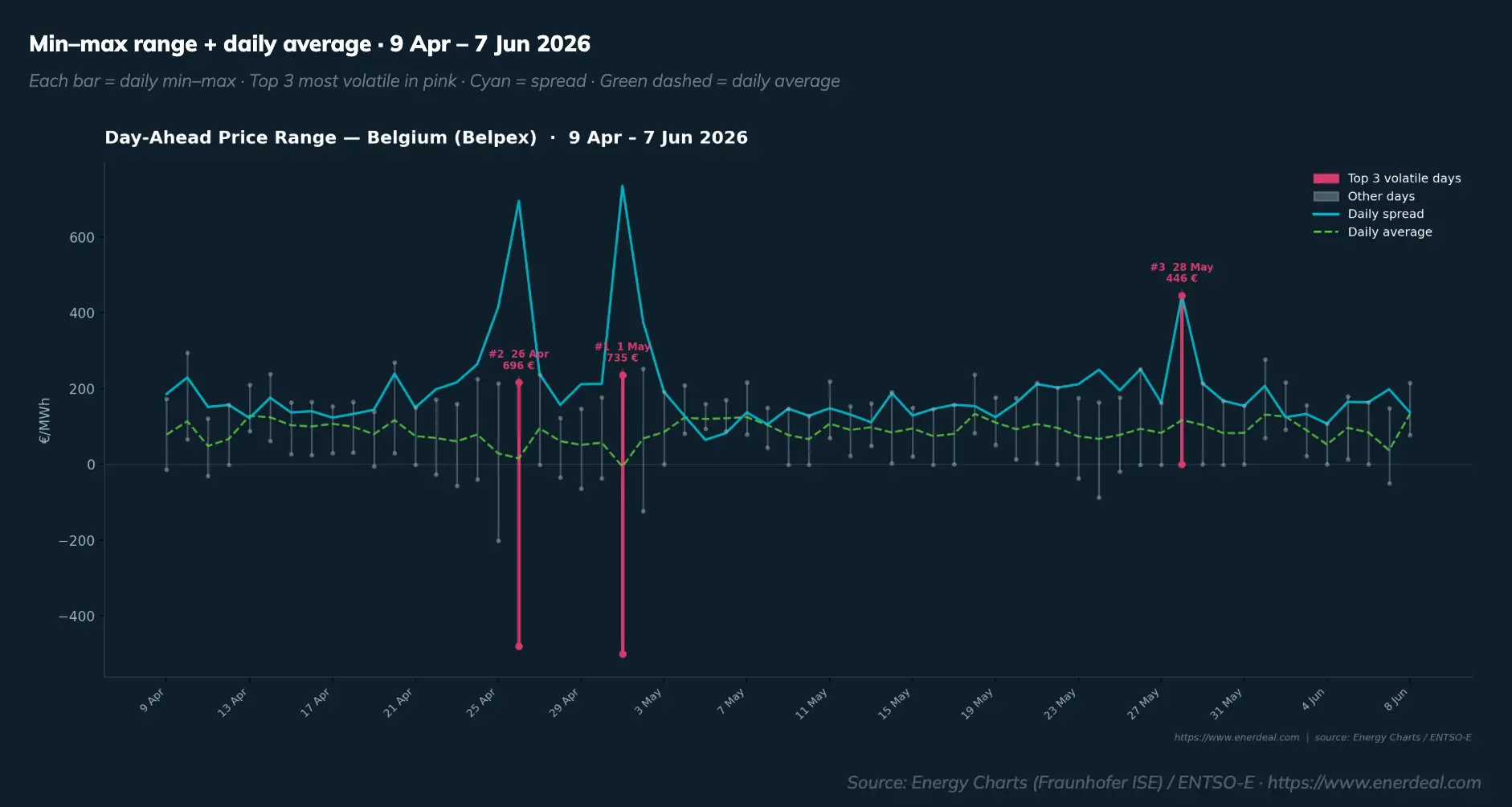
The Belgian electricity market has become much more dynamic. For a company capable of adjusting its consumption or managing a battery, these price fluctuations become a way to save money. These two dashboards track the Belgian market over the past 60 days.
Day-ahead Prices
Market-indexed contract: How to turn Belpex volatility into a source of savings
Electricity prices on the Belgian market no longer follow the same pattern as they did ten years ago. The rise of renewable energy has reshaped the seasonal price curve, and this spring of 2026 is yet another example of that.
The new pricing structure
Over the past 60 days, the average day-ahead price has hovered around €85/MWh. But behind this average lies a more nuanced reality: during daylight hours, from mid-morning through early afternoon, prices are consistently the lowest of the day. At night, however, the market remains dominated by thermal power plants and thus higher prices.
This is the shift we’ve been anticipating for several years: midday has become the cheapest time of day, when solar production is at its peak. For companies with Belpex-indexed contracts, this structure creates a direct advantage.
What smart management actually achieves
During this period, prices were zero or negative nearly 11% of the time. For a company with flexible energy consumption (industrial cooling, compressed air, electric vehicle charging), these periods represent opportunities to reduce energy costs without impacting production.
An EMS connected to real-time Belpex prices automatically shifts this energy consumption to off-peak hours. For a flexible load of 100 kW, monthly savings can reach several thousand euros, simply by consuming energy at the right time.
For solar power producers, the logic is complementary: rather than feeding electricity into the grid during times when prices are low, a smart battery stores this energy and sells it later. The result is a direct improvement in the return on investment for the solar installation.
Our approach
We analyze your consumption profile based on actual market data and calculate how much an EMS system would have saved you over the past 60 days.
Imbalance Market
Energy flexibility: Lessons from Belgium’s imbalance market this spring
Month after month, the Belgian imbalance market reflects a reality we see on the ground: the energy transition creates value for companies that prepare for it and additional costs for those that have not yet adapted.
Market conditions this spring
Over the past 60 days, the Belgian grid has fluctuated between periods of renewable overproduction and occasional imbalances in supply and demand. This fluctuation has led to volatility in imbalance prices, which, when properly interpreted, serves as a signal for flexible market participants to optimize their operations. Nearly 12% of the time, prices fell below zero, a proportion that directly reflects the rise of solar photovoltaics in Belgium.
What this means for your business
For a business owner with a solar PV system and a battery, these periods of negative prices are not a constraint. They are an opportunity. A battery connected to an energy management system (EMS) automatically capitalizes on these windows: it draws in the available low-cost energy, stores it, and releases it when the price is at its highest.
For a 100-kWh system, this arbitrage mechanism can result in significant monthly savings on the imbalance bill, without changing production processes or requiring any additional investment beyond the control system.
The key isn't just the battery. It's the brain behind it: an EMS connected to real-time market signals that makes the right decisions at the right time. That's exactly what we're implementing for our industrial clients.
Our approach
We use your actual consumption and production data to simulate what smart management would have achieved over the past 60 days. This simulation provides you with a factual basis for decision-making.