Agrivoltaics
Solar power plants on agricultural land for livestock and crops
Produce energy without sacrificing agricultural land
Agrivoltaics combine agriculture and renewable energy production, enabling dual land use while preserving agricultural productivity and improving climate resilience.
The same land can be used for farming and to generate solar power at the same time. This is the principle behind agrivoltaics. EDP supports farmers, livestock breeders and cooperatives in Belgium, France and Luxembourg in developing projects that generate stable additional income (land rent or a share of production), whilst improving the climate resilience of farms: shade in summer, shelter for animals, and reduced heat stress on crops.
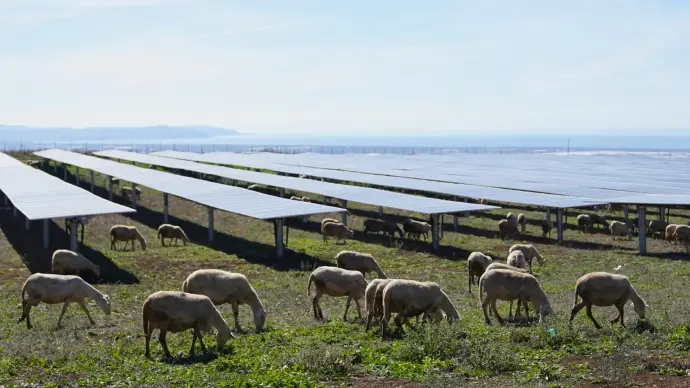

EDP & agrivoltaics: a long-term vision combining agriculture and solar power
Since 2009, EDP - Enerdeal has been developing solar projects in agricultural settings, adopting an approach that puts the farm at the heart of the process: no disruption to existing farming activities and comprehensive support from financing through to commissioning. Our teams work with farmers, livestock breeders, cooperatives and chambers of agriculture in Belgium, France and Luxembourg.
Ready to plant the seeds of your energy transition?
Our approach:
- Comprehensive agricultural, technical and economic feasibility study: Analysis of compatibility with your farming system (type of livestock farming, crops)
- Full compliance with agricultural requirements: Designs tailored to your specific farming activities (sheep/cattle farming, arable farming, market gardening, fruit and vegetable growing). Spacing designed to ensure unobstructed access for tractors and machinery. Close collaboration with you and your agricultural advisor
- Integration of agronomic solutions and field monitoring: Implementation of protocols for monitoring crop yields (before and after installation). Agronomic advice to optimise dual-use systems. Adaptation of crop and pasture management. Monitoring of animal welfare (livestock farming)
- Partnerships with agricultural stakeholders
- Financial structuring and subsidy support
FAQ
Agrivoltaics is suitable for various types of livestock farming: birds (with supporting structures that can create an aviary), poultry (chickens that can forage on the ground and be protected from predators with netting if necessary), sheep or goats that seek shade in summer, and even cattle with structures installed at a height of 2.5 meters. Feel free to contact us for photos of each of these examples.
The impact on agricultural yields depends on the type of operation and the project design. Best practices in system sizing, along with current regulations, ensure that agricultural yields are reduced by only 10% to a maximum of 20%, while providing additional benefits (rental income, improved animal welfare, increased soil moisture through partial shading, etc.).
The height and spacing of agrivoltaic panels are determined according to your agricultural activity. For extensive livestock farming (sheep, cattle): a minimum height of 1.5 to 2.5 meters to allow free animal movement. Spacing between rows of 6 to 8 meters for comfortable grazing. For intensive crops: spacing between rows of 7 to 12 meters to allow soil preparation and sowing with tractors, followed by harvesting with combine harvesters.
Yes, installing an agrivoltaic project requires a planning permit, as it involves structures several meters high that alter the landscape. Specific to agrivoltaics: authorities carefully assess the continued agricultural use of the land (supporting studies must be provided), the landscape impact (visual integration), the absence of soil sealing (lightweight structures are preferred), and the preservation of fauna and flora.